
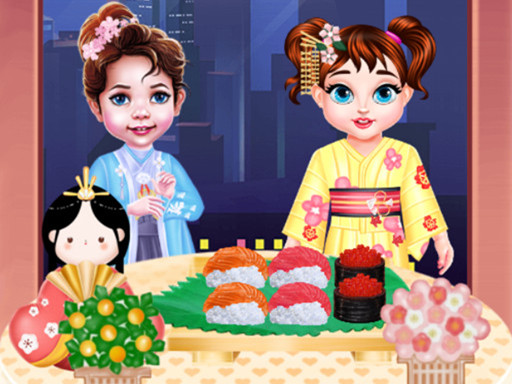
A Festival in Three Parts
Taylor and Jessica Hinamatsuri Festival is built around three connected activities that reflect the Japanese holiday known as Hinamatsuri, or Girls' Day. Rather than presenting cultural facts as text, the game turns them into tasks. Players begin in a kitchen, move to a doll display, and finish with a dress-up session. Each section uses the same input method, so children do not need to learn new controls between activities.
Making Sushi Rolls
The cooking portion asks players to assemble traditional sushi rolls. Ingredients such as rice, seaweed, and fillings appear on screen, and the game prompts the player to pick the correct items and drag them onto a work surface. There is no timer or failure state, so the focus stays on following the recipe step by step. The result is a simple introduction to how a familiar Japanese food is put together.
Decorating Hinamatsuri Dolls
In the doll section, players arrange ornaments on ceremonial dolls. Fans, flowers, and small stands are available, and each item is placed by clicking and dragging. Because the game does not enforce a single correct arrangement, children can try different layouts and see how the display changes. This mirrors the real festival's custom of setting up a tiered doll display, though the game presents it as a creative exercise rather than a strict historical lesson.
Kimono Dress-Up
The final activity lets players choose kimonos for both Taylor and Jessica. A selection of colors and patterns is paired with accessories such as hairpins, sashes, and sandals. Players build complete outfits for each character, which encourages comparison and experimentation. The dress-up section is the most open-ended part of the game, and it gives children a reason to replay the activity with different combinations.
Designed for Young Players
Across all three sections, the game relies on visual cues and simple clicks or taps. Instructions are kept short, and there are no wrong choices or penalties. This makes the game accessible to children who are still developing reading skills. The content stays family-friendly, with no ads or mature material, and the overall goal is to combine creative play with a basic awareness of Japanese festival customs.





Comments
0 comments