
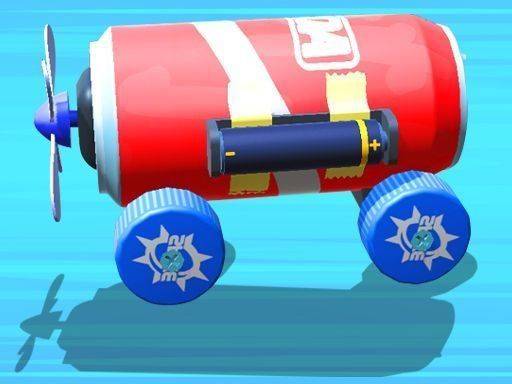
Assembling Vehicles in the Workshop
The core activity in Build & Drive Workshop 3D is constructing vehicles piece by piece. Players choose from components such as chassis frames, wheel types, and power sources, then assemble them using a drag-and-drop interface. Each part carries its own weight and properties, so where you place it and in what order matters. A heavy power source mounted high on the frame changes how the finished vehicle handles compared to the same part placed low. The building phase rewards planning, and a design that survives its first test run feels earned.
Physics on the Course
After assembly, the game switches to driving. Courses include slopes, bumps, and narrow paths, and the physics engine models weight distribution and traction. A poorly balanced vehicle may tip over on a steep incline or get stuck when its wheels lose grip. Terrain changes constantly, so steady control and quick corrections matter as much as raw speed. Each run teaches something about how the build interacts with the ground, and players can retry a level or return to the workshop to adjust their creation.
Unlocking New Environments
Completing courses opens new settings with different visual themes and terrain characteristics. Early areas feature grassy hills and gentle slopes, while later environments introduce rocky paths or sandy dunes. These shifts keep the scenery varied and add fresh physical demands without changing the core mechanics. A build that works on grass may struggle on sand, which pushes players to adapt their designs for each environment and extends replay value.
Experimentation and Replay
There is no single correct build for any course. A low, wide chassis improves stability on steep ramps, while a lighter frame favors speed on flat sections. This open-ended approach means that even after finishing the available levels, players have reason to return and try new configurations. The game supports creative problem-solving and personal expression through vehicle design, and the combination of building and driving keeps both halves of the experience connected.









Comments
0 comments