
Placing and Moving Pieces
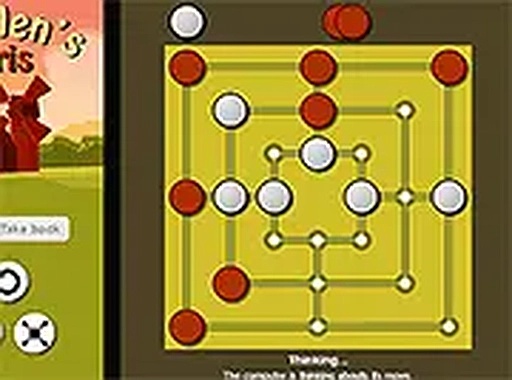
The game is played on a board marked with intersecting points. Players take turns placing their pieces on empty intersections during the opening phase. Once all pieces are on the board, the movement phase begins: each turn a player slides one piece along a connecting line to an adjacent empty point. The goal is to form a straight line of three pieces, known as a line formation. When a player completes a line, they remove one of the opponent's pieces from the board. This cycle of building threats and responding to them drives the match.
Three Phases of Play
Play progresses through three distinct phases. The placement phase establishes initial positions and early threats. The movement phase follows, where pieces slide to adjacent empty points along the board's lines. The final flying phase activates when a player is reduced to three pieces. In this phase, that player may move any of their pieces to any empty point on the board, ignoring adjacency. This rule creates a dramatic shift, giving the trailing player a chance to recover through unexpected placements.
Winning and Strategic Depth
A match ends when one player is left with only two pieces or cannot make a legal move. Success depends on anticipating the opponent's lines while building your own. Controlling central intersections often provides more movement options and line possibilities. A key tactic is to create multiple threats at once, forcing the opponent to block one while another succeeds. The flying phase demands especially careful positioning, as the ability to jump anywhere can quickly change the balance of power.
Browser-Based Convenience
This digital version preserves the classic rules and runs directly in a web browser on both mobile devices and desktop computers. No downloads or registration are required. A full-screen mode is available for a more focused experience. The game is free to play, making it easy to enjoy a quick match during a break or a longer strategic session.




Comments
0 comments