
Designing a Virtual Organism
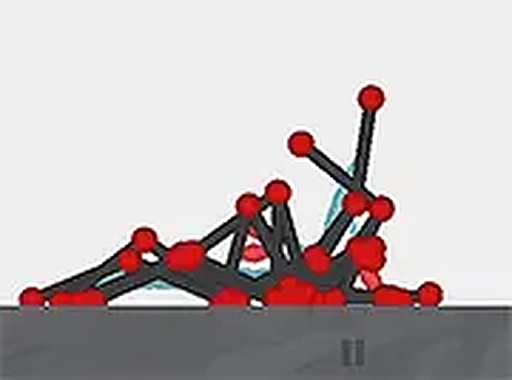
Every creature in AI Evolution Creature Designer begins as a construction problem. You choose structural parts: bones provide the skeleton, muscles generate force, and joints determine flexibility. These components connect in any arrangement you can imagine, letting you build a body from scratch. The interface relies on mouse interaction, and a full-screen mode gives you a clearer view of your design. Because the parts behave according to simulated physics, the shape you assemble directly influences how the creature moves once evolution begins.
Evolution Through Neural Networks
After building a creature, you select a movement task such as running, walking, or jumping. The game then runs simulations across many generations. Neural networks control the creature's attempts, while genetic algorithms refine its traits over time. Each generation learns from the previous one through trial and error, mirroring biological adaptation. You can watch the process unfold and see visual feedback on speed, balance, and coordination. There is no time limit, so evolution proceeds at whatever pace you prefer.
Iteration and Experimentation
The process is deliberately iterative. You can adjust the design at any point and immediately test how changes affect performance. Trying different configurations helps you find a more efficient body plan. Because each creature learns uniquely based on its structure, outcomes are often surprising. The game encourages critical thinking and experimentation in a safe environment, making it suitable for players curious about biology, physics, or artificial intelligence.




Comments
0 comments