
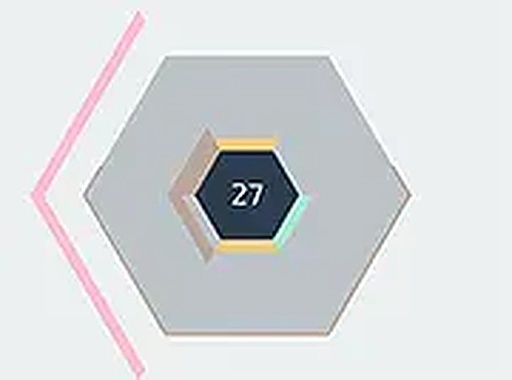
Rotating the Hexagon
Hex 3 Block Puzzle uses a six-sided playfield instead of a flat grid. Each face holds a stack of colored blocks. Blocks drop from the outer edges toward a central blue hexagon. Your only control is rotation: turn the hexagon left or right so incoming blocks land on the correct stack. Because every face is visible at once, you are always managing several stacks rather than one column. [IMG_1]
Matching and Clearing Stacks
The core rule is straightforward. When three or more blocks of the same color are stacked together, that group clears and frees space. The difficulty comes from timing. Blocks fall continuously, and new colors arrive while you are still arranging earlier ones. You need to decide whether to clear a small group now or hold it for a larger match later. That trade-off is the main source of strategy.
The Safe Zone and Failure State
A grey hexagon boundary marks the limit for each stack. If any stack grows past that line, the game ends. This creates constant pressure without needing a timer or lives system. You lose when your own placement decisions let a stack overflow, not when an arbitrary clock runs out. Keeping all six sides balanced matters as much as clearing colors quickly.
Controls and Platform
Hex 3 Block Puzzle runs directly in a browser with no download. On desktop, use the mouse to rotate the hexagon. On mobile, use touch. A full-screen option is available for a cleaner view. The simple input scheme means the challenge comes from spatial planning and reaction speed rather than complex commands. [IMG_2]
Who It Suits
Short sessions work well because the pace escalates gradually. The hexagonal layout asks you to track six positions at once, which is more demanding than a standard four-column stacker. Players who enjoy quick color-matching puzzles and want a spatial twist will find the format familiar but not identical to Tetris-style games.



Comments
0 comments