
Drawing as Your Only Defense
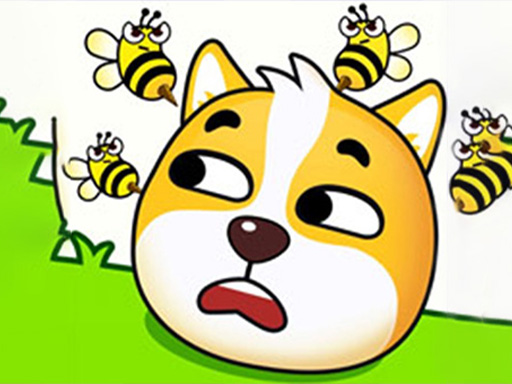
Every level in Doge Shield Puzzle gives you a single tool: a virtual crayon. You draw lines on the screen to form walls between the doge and whatever is trying to reach it. Bees arrive first, and later stages add falling stones and pools of poisoned water. The doge does not move on its own, so your drawn barriers are the only thing keeping it safe.
Timed Survival and Hazard Patterns
Each round asks you to survive for a set duration, usually around ten seconds. That short window changes how you plan. You cannot cover every angle, so you watch where hazards come from and draw where the pressure is heaviest. Bees tend to cluster, and obstacles become more frequent as you progress, which means the same wall placement that worked early may fail later. Learning the timing of each hazard type matters as much as drawing speed.
Why Wall Placement Takes Thought
Walls take time to create, and you can draw more than one. That creates a small but real trade-off: a long wall blocks more space but leaves you exposed while the crayon moves, while a short wall is faster but covers less. Planning a moment before drawing often beats reacting instantly. If a hazard touches the doge, the level restarts, so each attempt is a chance to test a different layout.
Designed for Younger Players
The controls are click or tap, with no menus or button combinations to memorize. Bright graphics and a non-violent premise keep the tone light. Because it runs in a browser without downloads, it works on phones, tablets, and computers, which makes it easy to hand to a child at home or during a wait.




Comments
0 comments