
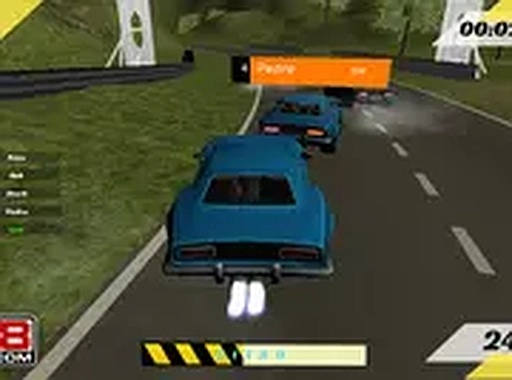
Track Design and Visual Focus
Turbo Circuit Dash organizes its racing into a sequence of circuits that become more complex as you advance. Early tracks favor simple layouts, while later ones add tighter turns and longer straight sections that punish sloppy lines. The visual style stays clean and functional, keeping attention on the road. Background elements shift subtly between circuits, so progress feels tangible without distracting from the driving. The game runs in full screen, which reinforces focus on the race itself.
Handling and Input
Before each race, you pick a car color from a set of options. Controls are built for keyboard and mouse, covering acceleration, braking, and steering. The handling model rewards smooth inputs and consistent racing lines rather than sudden, aggressive maneuvers. There is no deep mechanical tuning, so the color choice is mostly a personal touch. The responsive controls help players of different skill levels settle in quickly.
Racing Against AI and Unlocking Circuits
The core loop is straightforward: race against AI opponents and finish first. Winning earns rewards that unlock new circuits. Difficulty scales as you progress—opponents drive more skillfully and tracks demand greater precision. There are no tournament brackets or elimination rounds, so the experience stays accessible and centered on the act of racing.
Improving Your Lap Times
Success in Turbo Circuit Dash comes from learning each track's layout and building consistent habits. Focus on steady cornering and avoid unnecessary risks. Practicing familiar circuits helps you internalize braking points and turn-in angles. Because progression depends on mastering earlier tracks, repeated play is part of the design, and that practice-and-reward loop keeps the game engaging across multiple sessions.





Comments
0 comments